Team

BIOPIC

For opportunities to join the lab, please have a look here.

Group leader:

  • Damaris Zurell (PhD) - Professor of Ecology & Macroecology at University of Potsdam

Administrative assistant:

Scientific programmers:

Senior & Postdoctoral researchers:

  • Maira Cardoso (PhD) - macroecology, biodiversity conservation, bird diversity, global change
  • Mariana Chiuffo (PhD) - Humboldt fellow, plant community ecology, species interactions, invasion biology
  • Emy Guilbault (PhD) - distribution modelling, statistical ecology, global change
  • Bettina Ohse (PhD) - Individual postdoc project, functional biodiversity, forest disturbances
  • Coline Royaux (PhD) - Postdoc within University Focus Area Individual-based global change ecology, freshwater diversity from genes to communities, ecological coupling, dispersal
  • Patricia Singh (PhD) - Individual postdoc project, peatland ecology, range shifts, ecological forecasting
  • Juliane Wolter (PhD) - Individual postdoc project, paleoecology, effects of Arctic vegetation changes on carbon dynamics

Doctoral researchers:

  • Valén Holle - ZOE project, PhD thesis on modelling biodiversity-disease relationships and hotspots of zoonotic disease emergence (ZOE project)
  • Raya Keuth - PhD thesis on understanding and predicting species extinctions (DBU scholarship)
  • Anna Rönnfeldt - NichePac project, PhD thesis on understanding and predicting niche and spread dynamics of Pacific plant invaders (NichePac project)
  • Katrin Schifferle - DEBTs project, PhD thesis on detecting and attributing biodiversity trends in North American birds (DEBTs project)
  • Tim Westermann - PhD candidate within University Focus Area Individual-based global change ecology, telecoupling of ecosystem functions through mobile linkers
  • Levin Wiedenroth - Birdwatch project, PhD thesis on species distribution modelling & optimisation of greening measures for farmland birds (Birdwatch project)

Research assistants, Bachelor & Master students:

  • Clara Franz Berenguer - research assistant, acoustic monitoring
  • Johanne Burmeister - research assistant, data analyses, distribution modelling
  • Leonhard Grabsch - Master thesis on Systematic conservation planning for protected area expansion in Germany
  • Josh Hauer - Master thesis on Optimising monitoring schemes for detection of biodiversity trends

Alumni:

  • Former lab members are listed here.

Research themes

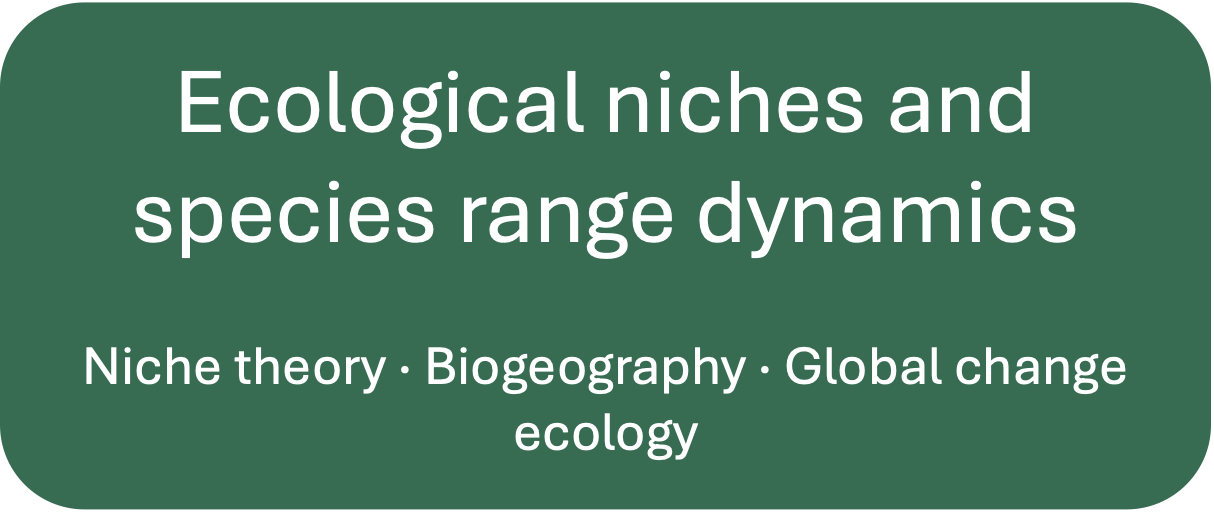
Ecological niches and species range dynamics

What determines where species occur, and how do their niches and ranges change through time?

...

Species distributions are determined by the complex interplay of environmental constraints, species interactions, demography, dispersal and evolutionary history. We study how ecological niches and geographical ranges are shaped by these processes and how they shift under environmental change. Niche dynamics, intraspecific variability and the ability of species to track changing conditions are central questions. We combine niche theory with empirical data and process-based models to identify what drives and constrains range dynamics.

Projects: NichePac, BeyondSpecies, RangeDyna

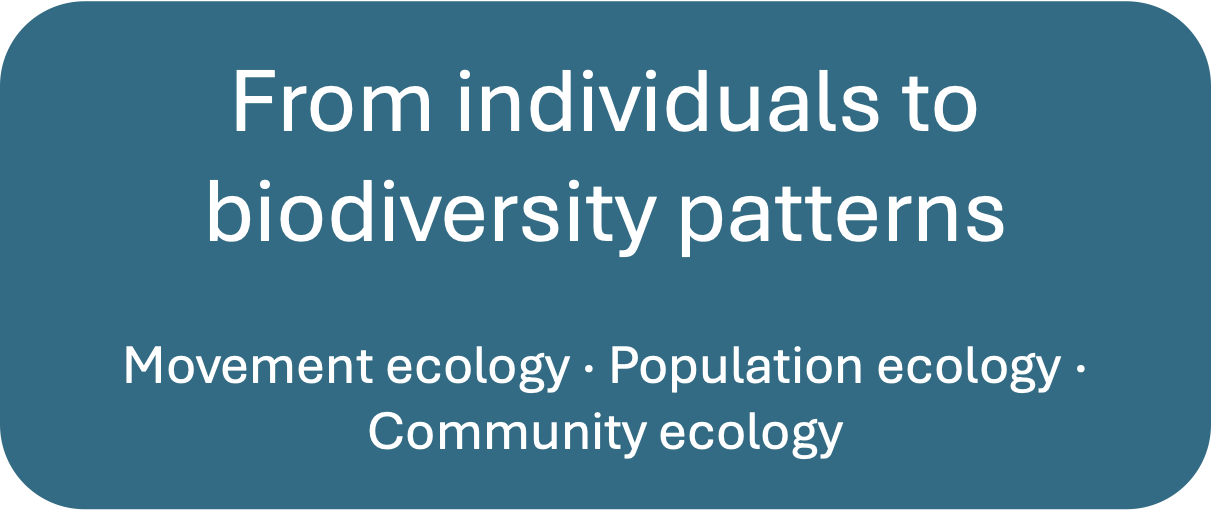
From individuals to biodiversity patterns

How do biodiversity dynamics emerge from individual behaviour and species interactions?

...

Large-scale biodiversity patterns emerge from individual dynamics. Variation among individuals, demography, movement and interactions between species all feed into the dynamics of populations and communities. We are especially interested in how dispersal and animal movement connect populations across heterogeneous landscapes, and how local interactions add up to biodiversity responses at large scales. Linking individual-based ecology with macroecology lets us explain where biodiversity patterns come from and how they respond to change.

Projects: BIOPIC, SCODA, MATES, University Focus Area IBE:CHANGE

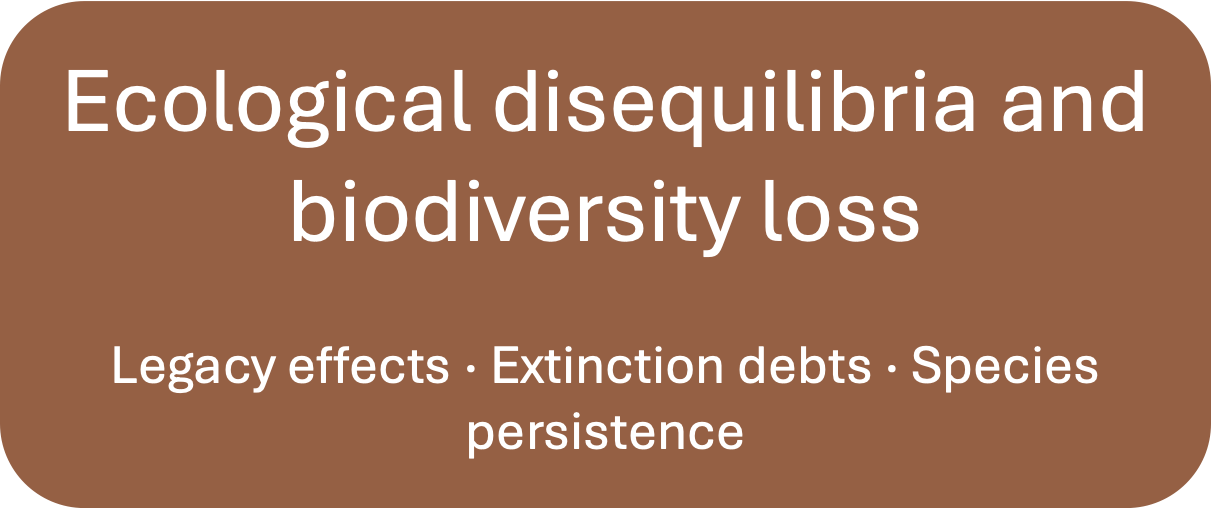
Ecological disequilibria and biodiversity loss

How do past, present and future environmental changes shape biodiversity dynamics?

...

Biodiversity rarely responds to environmental change right away. Past conditions, demographic processes and limited dispersal leave legacies that can last for decades. We ask how these disequilibria come about, how they influence present-day biodiversity patterns, and what they mean for future populations and communities. Our focus is on delayed responses to climate and land-use change, on extinction debts and on the mechanisms that allow species to persist. Taken together, this work traces how past, present and future biodiversity are linked.

Projects: ExChange, DEBTs

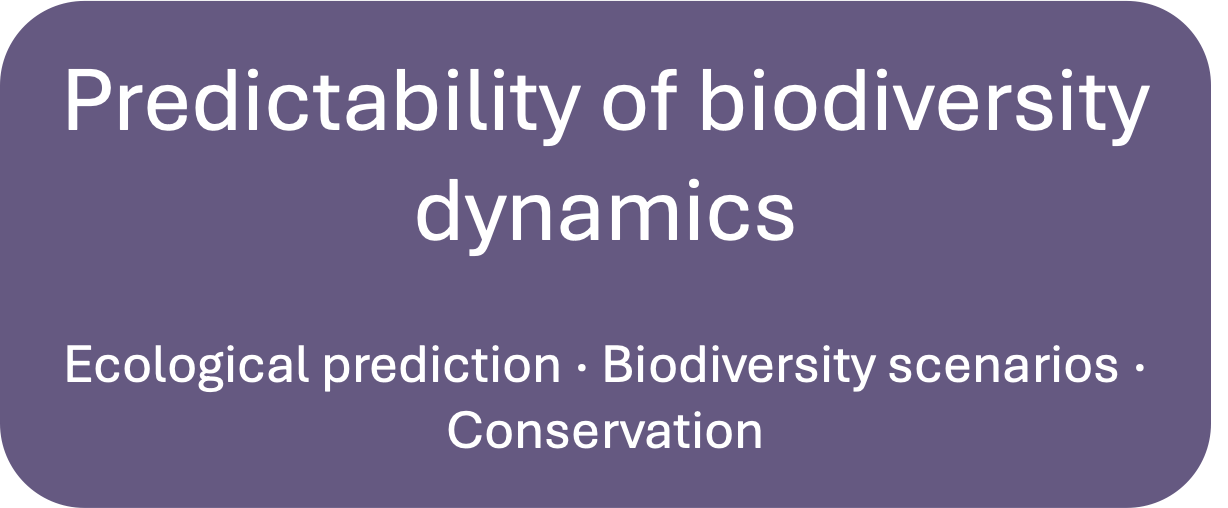
Predictability of biodiversity dynamics

What makes biodiversity dynamics predictable, and what limits our ability to anticipate ecological futures?

...

Predicting biodiversity change requires knowing when prediction is possible at all. We examine how ecological processes, environmental drivers, spatial and temporal scales, and uncertainty in data and models affect predictability. This covers near-term responses as well as long-term trajectories under different environmental and management scenarios. By combining ecological theory, biodiversity observations and quantitative models, we map out where prediction works, where it breaks down, and what that means for conservation and decision-making.

Projects and initiatives: TripleBird, BirdWatch, EcoCode

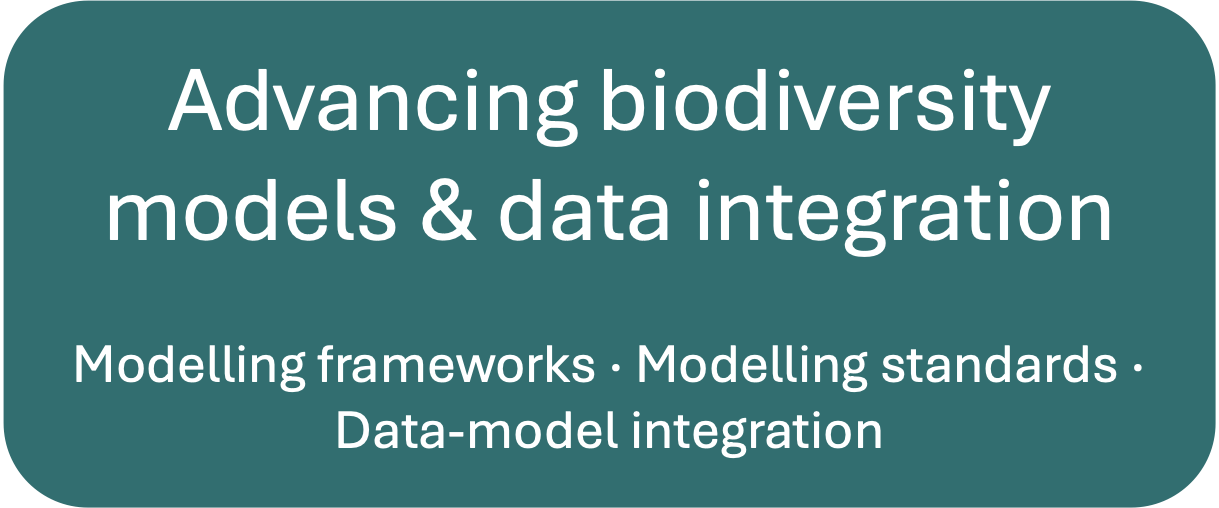
Integrating theory, data and models

How can we better integrate observations and models to understand and anticipate biodiversity change?

...

We advance the conceptual and methodological foundations of biodiversity modelling, focusing on species distribution models and on spatially explicit, individual-based and eco-evolutionary models. A central challenge is connecting complex models to empirical data. We develop ways to combine diverse biodiversity data sources, to fit process-based simulations to observations, and to test whether models reproduce observed ecological dynamics. We also explore how automated and AI-assisted monitoring can change the way biodiversity data are collected and processed.

Our work includes international standards and best practices for species distribution modelling and the co-development of RangeShifter, an open-source platform for simulating spatial population dynamics and eco-evolutionary processes. Through methodological innovation, data–model integration, open-source software and community initiatives, we aim to make biodiversity modelling more reliable, reproducible and firmly grounded in data.

Projects and initiatives: RangeShifter, Audiomonitoring, sModelProBio, EcoCode, ISIMIP, COMECO, SPEEDMIND

Projects

ExChange

Assessing species extinction risk from climate change in the past, present, and future - funded by the German Science Foundation DFG (2026-2029).

BirdWatch

Copernicus-based service for the improvement of habitat suitability of farmland birds - funded by HORIZON-EUSPA-2021-SPACE (2023-2026).

TripleBird

Bending the curve of biodiversity loss (since 2025)

BeyondSpecies

Predicting biodiversity change by integrating genetic diversity into ecological niche models - Leibniz Cooperative Excellence Project (2021-2024)

ZOE

Zoonoses Emergence across Degraded and Restored Forest Ecosystems - funded by HORIZON-CL6-2023-BIODIV-01 (2024-2027)

BIOPIC

Understanding population and community response to global change - Emmy Noether project funded by the German Science Foundation DFG (2018-2023).

DEBTs

Drivers of past and future population and community dynamics in North American breeding birds - funded by the German Science Foundation DFG (2023-2026).

NichePac

Niche and spread dynamics of introduced alien plants in Pacific - funded by the German Science Foundation DFG (2023-2026).

COMECO

Improved automated image recognition for identifying plants of Switzerland - Interdisciplinary project funded by the Swiss Data Science Center (2020-2022).

Audiomonitoring

Automated bioacoustic monitoring of birds, bats and insects.

RangeShifter & RangeShiftR

The RangeShifter platform - an eco-evolutionary modelling framework.

RangeDyna

Moving from pattern towards process for improved forecasts of species range dynamics - DAAD research exchange with Univ. Melbourne (2019-2020).

SPEEDMIND

Improving species biodiversity analyses and citizen science feedback - Interdisciplinary project funded by the Swiss Data Science Center (2017-2019).

SCODA

Scaling from individual interactions to community dynamics in avian assemblages - Ambizione project funded by the Swiss National Science Foundation SNF (2016-2019).

MATES

Understanding and predicting multispecies assemblages and interactions - Marie Curie fellowship funded by FP7 (2014-2016).

PhD thesis

Improve species range predictions for scenarios of environmental change - PhD research (2007-2011).

Publications

You can find a full list of my publications here.

My ResearcherID is E-2439-2012. You can also find me on ResearchGate and GoogleScholar.

Teaching

Current teaching:

Downloads

You can download some of my codes from my github site.

Latest software developments in my team include:

  • an R package for the RangeShifter platform. More info under https://rangeshifter.github.io
  • a Shiny web app introducing and facilitating the usage of the ODMAP protocol for reporting SDM. Check out here: odmap.wsl.ch

Contact